Cataracts
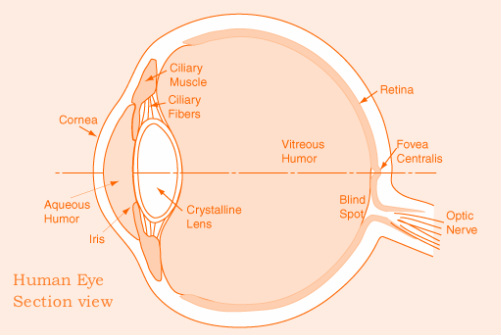
Human eye cross-sectional view, showing position of human lens. Courtesy NIH National Eye Institute
A Cataract is a clouding or opacity in the Crystalline Lens of the eye. The lens sits behind the pupil and when cloudy it is like looking through a dirty window. Age Related Cataracts develop very slowly throughout one’s life and everyone will have a vision effecting cataract if they live long enough. Age-Related Cataracts tend to affect vision in those usually over the age of 60, and if you live long enough you will get one!
Symptoms: Cataracts slowly result in blurred vision, increased glare, decreased night vision, decreased color vision sensitivity, decreased contrast sensitivity and cataracts may change your spectacle prescription. Increased lighting may help with reading in patients with cataracts but be careful to avoid glare.
Types and Causes: There are different types of cataracts based on either how they were created or where and what type of cloudiness is in the lens. Nobody knows exactly why cataracts develop, but we do know some things that can speed up the process or cause them. Steroid drug use, diabetes, and trauma may all cause cataracts early in a patient’s life. Age related Cataracts are thought to be more related to UV light exposure and radiation over ones lifetime.
Prevention: It is thought that antioxidants and UV protection such as sunglasses may slow the progression of Age Related Cataracts.
Treatment: Cataract surgery is used to treat cataracts. Surgery is safe, fast, and very effective. In cataract surgery the cloudy lens is removed and usually replaced with a clear artificial lens. The surgery will usually result in a change of spectacle prescription meaning you may need a different pair of glasses after the surgery. Medicare will usually cover most of the cost when a patient’s vision deteriorates to 20/50 or worse (when a patient can no longer pass a driver’s test). You can read more about cataract surgery Here
Secondary Cataracts: Posterior Capsular Opacification may occur in some patients after cataract surgery. This is when the bag that holds the artificial lens becomes cloudy. This is easily treated with Laser Surgery by blasting a hole in the cloudy portion of the bag resulting in a clear window for the eye to see through.
You can read more about Cataracts Here.
Symptoms: Cataracts slowly result in blurred vision, increased glare, decreased night vision, decreased color vision sensitivity, decreased contrast sensitivity and cataracts may change your spectacle prescription. Increased lighting may help with reading in patients with cataracts but be careful to avoid glare.
Types and Causes: There are different types of cataracts based on either how they were created or where and what type of cloudiness is in the lens. Nobody knows exactly why cataracts develop, but we do know some things that can speed up the process or cause them. Steroid drug use, diabetes, and trauma may all cause cataracts early in a patient’s life. Age related Cataracts are thought to be more related to UV light exposure and radiation over ones lifetime.
Prevention: It is thought that antioxidants and UV protection such as sunglasses may slow the progression of Age Related Cataracts.
Treatment: Cataract surgery is used to treat cataracts. Surgery is safe, fast, and very effective. In cataract surgery the cloudy lens is removed and usually replaced with a clear artificial lens. The surgery will usually result in a change of spectacle prescription meaning you may need a different pair of glasses after the surgery. Medicare will usually cover most of the cost when a patient’s vision deteriorates to 20/50 or worse (when a patient can no longer pass a driver’s test). You can read more about cataract surgery Here
Secondary Cataracts: Posterior Capsular Opacification may occur in some patients after cataract surgery. This is when the bag that holds the artificial lens becomes cloudy. This is easily treated with Laser Surgery by blasting a hole in the cloudy portion of the bag resulting in a clear window for the eye to see through.
You can read more about Cataracts Here.